Proton Definition
A proton is a positively charged subatomic particle found in the nucleus of an atom. Its electric charge is +1 elementary charge, and its symbol is p.

What is a proton?
A proton is one of the particles that make up atoms. It is found in the atom’s nucleus alongside neutrons.
Protons are nucleons, the particles that make up atomic nuclei. A proton is considered stable.
Proton charge and mass
A proton has a positive electric charge of +1 elementary charge. An electron has an equal-sized negative charge, while a neutron has no electric charge.
A proton’s mass is slightly less than a neutron’s and about 1,836 times the mass of an electron.
Why protons matter in atoms
The number of protons in an atom’s nucleus determines which chemical element it is. For example, every hydrogen nucleus has one proton.
A neutral atom has the same number of electrons as protons, so their opposite charges balance.
Questions people ask
What is a proton?
A proton is a positively charged subatomic particle found in an atom’s nucleus.
What charge does a proton have?
A proton has a positive charge of +1 elementary charge.
Where are protons found?
Protons are found in the nucleus at the center of an atom.
What does the number of protons tell you?
It identifies the chemical element. Atoms of the same element have the same number of protons.
Keep exploring
- PageATP in Biology and MedicineATP, or adenosine triphosphate, is a molecule cells use to transfer energy for essential processes. In medicine, ATP is also a term used in specific clinical contexts, including some treatments for abnormal heart rhythms; its use depends on the condition and local practice.
 PagePhotosynthesis: Definition and ExplanationPhotosynthesis is the process plants, algae, and some bacteria use to turn light energy into chemical energy. In the common oxygen-producing form, they use water and carbon dioxide to make sugars and release oxygen.
 PageSpace: Meaning and DefinitionSpace is the framework of distances and directions where objects have positions. In physics, it is usually described as three-dimensional and, together with time, as part of four-dimensional spacetime.
 PagePotential Energy: Definition and ExamplesPotential energy is energy associated with an object’s position or with the arrangement of parts in a system. For example, a raised object has gravitational potential energy, while a stretched spring has elastic potential energy.
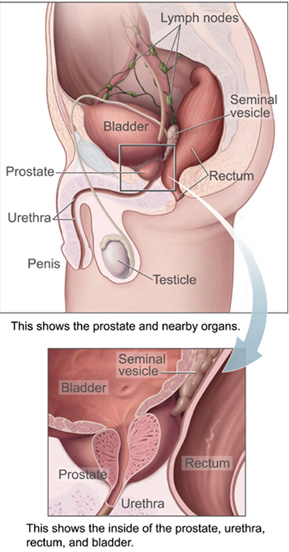 PageWhat Is the Prostate?The prostate is a gland in the male reproductive system, located below the bladder and around part of the urethra. It makes fluid that becomes part of semen and can affect urination if it grows or develops a health problem.
 PageWhat Is Protein?Protein is a nutrient made of amino acids and a biomolecule found in every living organism. In the body, proteins help build and maintain tissues and carry out many essential tasks.