Osmosis: Definition and Examples
Osmosis is the net movement of solvent—usually water—through a selectively permeable membrane from an area of higher water potential to lower water potential. This movement tends to reduce differences in solute concentration on either side of the membrane.
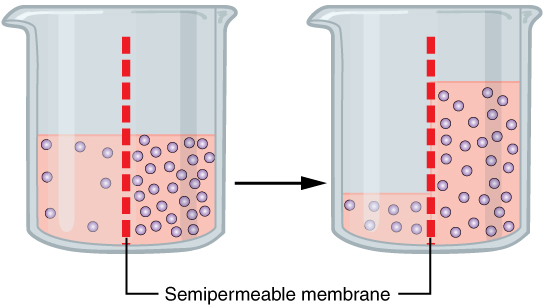
What osmosis means
Osmosis is the net movement of solvent molecules across a selectively permeable membrane. The membrane allows the solvent to pass through more easily than certain dissolved substances.
When the solvent is water, it tends to move from the side with lower solute concentration toward the side with higher solute concentration, if the membrane separates the two sides and does not let those solutes pass. The movement continues until conditions balance or another force limits it.
Examples of osmosis
A raisin placed in water can swell as water moves through its skin into the raisin. The raisin’s dissolved substances contribute to the difference that drives the movement.
Plant cells also take in water by osmosis. Water entering a plant cell helps press its contents against the cell wall, which supports the plant’s firmness.
Osmotic pressure and related terms
Osmotic pressure is the external pressure needed to prevent net solvent movement across a selectively permeable membrane. It depends on the concentration of dissolved particles, not on what those particles are.
Osmosis is related to diffusion, but the terms are not interchangeable: osmosis specifically describes net solvent movement across a selectively permeable membrane. The direction and amount of movement can be affected by differences in pressure as well as by differences in water potential.
Questions people ask
What does osmosis mean?
Osmosis is the net movement of a solvent, usually water, through a selectively permeable membrane. It moves in the direction that tends to reduce differences in solute concentration.
What is a simple example of osmosis?
A raisin may swell when soaked in water as water moves through its skin. Water entering plant cells is another example.
How is osmosis different from diffusion?
Diffusion is the net movement of particles down a concentration gradient. Osmosis specifically refers to solvent movement across a selectively permeable membrane.
Which way does water move during osmosis?
Water tends to move toward the side with lower water potential, often the side with more dissolved solute, when the membrane allows water through but restricts that solute.
Keep exploring
 PagePotential Energy: Definition and ExamplesPotential energy is energy associated with an object’s position or with the arrangement of parts in a system. For example, a raised object has gravitational potential energy, while a stretched spring has elastic potential energy.
- PageSentences: Types and ExamplesA sentence is a group of words that expresses a complete thought. In English, sentences can make statements, ask questions, give commands, or express strong feelings.
- PageHyperbole: Definition and ExamplesHyperbole is deliberate exaggeration used to emphasize an idea or create a strong impression. It is usually figurative, not meant to be taken literally, as in “I’ve told you a million times.”
- PageAmbiguity: Meaning and ExamplesAmbiguity is uncertainty about meaning: a word, phrase, statement, or situation can be understood in more than one plausible way. Context often helps clarify which interpretation is intended.
- PageConsensus: Meaning and ExamplesConsensus means general agreement among a group. It does not always mean that every person agrees completely; it can mean the group has found an outcome most members can accept.
 PagePhotosynthesis: Definition and ExplanationPhotosynthesis is the process plants, algae, and some bacteria use to turn light energy into chemical energy. In the common oxygen-producing form, they use water and carbon dioxide to make sugars and release oxygen.